
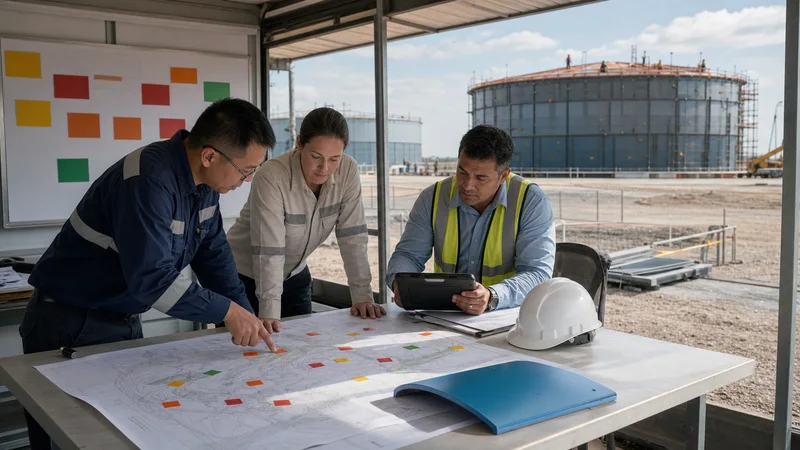
International storage tank projects involve linked decisions across engineering, factory production, inspection, packing, transport, civil interfaces, site installation, and final handover. A risk register gives the project team one place to identify what could affect the agreed scope, quality, delivery sequence, cost, site readiness, or safe execution. More importantly, it creates an early-warning routine so that a risk is discussed while the team can still take practical action.
A risk register is not a prediction that a project will fail, and it is not a substitute for engineering judgment, contract terms, safety procedures, quality plans, or change control. It is a disciplined working record. For each relevant risk, the team describes the condition, potential effect, current control, responsible owner, next action, target date, and indicator that tells the team whether the risk is increasing or closing.
Start with the project basis and open assumptions
Risks are easier to manage when the project basis is clear. The register should begin with the awarded tank scope, stored media, capacity, dimensions, coating or material route, roof and accessory package, nozzle schedule, applicable standards, foundation assumptions, inspection requirements, delivery terms, installation responsibility, and required documents. Any unknown or conditional item should be recorded as an assumption with an owner and date for confirmation.
The project kickoff meeting checklist explains how these inputs can be aligned before production release. The risk register carries that work forward by showing which assumptions remain open and what may happen if they are not resolved in time.
Identify risks across the full project path
A useful register does not focus only on factory risks or only on site risks. It follows the actual delivery path. Early risks may include incomplete media information, pending drawings, unclear standards, unconfirmed roof openings, missing nozzle data, or unclear civil interfaces. Production risks may include late approvals, material availability, inspection timing, accessory changes, or document gaps. Logistics and site risks may include packing marks, container availability, customs documents, storage conditions, lifting access, foundation readiness, weather, local labor, or interface work by other contractors.
The team should avoid listing generic items such as "delay" without a cause. A stronger entry identifies the condition that could create the delay, the affected milestone, and the decision or information needed to prevent it.
Use risk fields that lead to action
Each register line should be concise enough to review in a meeting but specific enough to drive an action. Typical fields include project reference, risk category, description, cause, possible effect, related drawing or document, likelihood, impact, current control, risk owner, action owner, target date, status, early-warning indicator, and closure evidence.
Some projects also use a priority score, but scores should not replace explanation. A medium score with a fixed decision deadline can deserve more attention than a high score with a robust mitigation already in place. The register should help people decide what to do next, rather than create a numerical report with no practical follow-up.
Define early-warning indicators
An early-warning indicator is a visible signal that a risk may be growing. For engineering, it could be an overdue drawing approval, an unresolved nozzle location, a missing stored-media value, or comments that change the tank basis. For production, it could be a delayed material release, an unclosed inspection finding, a changed accessory requirement, or a document still awaiting buyer response. For logistics, it could be incomplete packing data, an unconfirmed container booking, or a missing consignee instruction.
The indicator should be observable and connected to a review point. A vague statement that the team will "monitor closely" is less useful than a defined condition such as "roof layout approval is required before the production release date" or "container-loading plan must be confirmed before packing completion."
Connect risks with drawing and document control
Many tank-project risks begin as document-control issues. A drawing may be under review while a related production activity is approaching. A change in nozzle orientation may affect roof openings, pipe interfaces, accessory scope, packing, and site assembly. A certificate or inspection record may be needed before a buyer can release the next stage.
The document transmittal register guide explains how issue, revision, recipient, status, and response can be recorded. The risk register should refer to the relevant transmittal or drawing revision so that the team can see the actual evidence behind an open risk.
Keep quality risks separate from non-conformances
A quality risk is a condition that could lead to a problem; a non-conformance is a recorded issue against an agreed requirement. The register can identify a risk such as an upcoming witness inspection with an unconfirmed inspector, a critical accessory with a late document, or a packing stage that depends on an open approval. If an actual requirement is not met, the project should use its agreed NCR process rather than treating the event as only a future risk.
The NCR management guide explains how evidence, impact, responsibility, corrective action, approval, and closure should be handled once a non-conformance is found. Cross-references between the two records help the team distinguish prevention from corrective action.
Review factory, inspection, and shipment dependencies
Before materials move toward final packing, the register should review the dependencies that protect delivery readiness. These may include approved drawings, production release, component availability, quality records, witness or hold points, third-party inspection notice, accessory completion, packing list, shipping marks, container plan, document compilation, and shipment authorization. The correct dependencies vary by contract, but they should be visible before the last possible moment.
The inspection and test plan guide provides a framework for quality activities and releases, while the export packing and container loading guide covers the records that connect finished materials with international delivery. The risk register should flag the open conditions that may prevent either process from moving forward.
Use site risks to protect installation readiness
Site risks are often discovered too late because the factory and site team are working on different timelines. The register should include foundation handover status, levelness or interface questions, unloading area, crane or lifting availability, storage conditions, access routes, weather exposure, safety requirements, local labor readiness, equipment interfaces, and temporary power or tools where relevant. These are not minor site details; they can change installation sequence and material protection requirements.
The installation preparation checklist describes the practical items that should be confirmed before containers arrive. A risk entry should show what remains uncertain, who will verify it, and what action is needed before delivery or assembly begins.
Assign ownership and escalation clearly
Every open risk needs one accountable owner, even when several parties contribute to the solution. The owner may be the buyer, EPC team, consultant, tank supplier, inspector, logistics coordinator, installer, or site representative. The register should state who updates the status, who provides the required input, and who makes the final decision if the risk affects cost, schedule, scope, quality, or safety.
Where a decision is overdue, the project should follow an agreed escalation path. The goal is not to assign blame. It is to prevent an unresolved issue from becoming an unplanned production hold, shipment delay, or site problem. The communication and responsibility matrix guide can help identify these routes.
Review the register on a fixed cadence
The register should be reviewed at a frequency that matches the project stage. During early engineering, the focus may be drawings, data, interfaces, and approvals. During production, it may shift to inspection, material readiness, changes, and release records. During packing and shipment preparation, logistics and document dependencies become more important. At site, the register should focus on receiving, storage, foundation, lifting, installation, and commissioning interfaces.
A short review of the highest-priority and newly changed risks is often more useful than a long meeting that reads every closed item. The register should preserve history, but the meeting should focus on actions, deadlines, and early warnings that require a decision.
Handle changes through the correct control route
A risk register may reveal that a change is needed, but it should not approve that change by itself. If the solution changes tank scope, price, schedule, quality requirement, or responsibility, the parties should use the agreed change-control process. The change order control guide explains why the record, approval route, and impact assessment need to remain clear.
This distinction keeps the risk register useful: it can highlight the need for action without turning every early warning into an informal technical or commercial instruction.
Practical risk-register fields
- Risk category, description, cause, potential effect, and related project stage
- Relevant drawing, transmittal, requirement, inspection record, packing record, or site interface reference
- Likelihood, impact, priority, current control, and defined early-warning indicator
- Risk owner, action owner, required decision, target date, and escalation route
- Status, next review date, closure evidence, and cross-reference to NCR, RFI, or change record where needed
Where product information fits
Risk control supports a project-specific tank package; it does not replace technical selection. Buyers can begin with detailed context such as GFS tank information, then connect the selected route with actual project data, quality requirements, packing, site conditions, and responsibility boundaries. Center Enamel's company site supports the manufacturing, documentation, quality, and coordination evidence needed for that review.
Practical takeaway
A risk register helps international tank projects act before a problem becomes a delay or a site issue. By linking real conditions with early-warning indicators, named owners, practical actions, document evidence, and fixed review points, buyers and project teams can manage uncertainty across design, production, inspection, delivery, installation, and handover with greater control.