
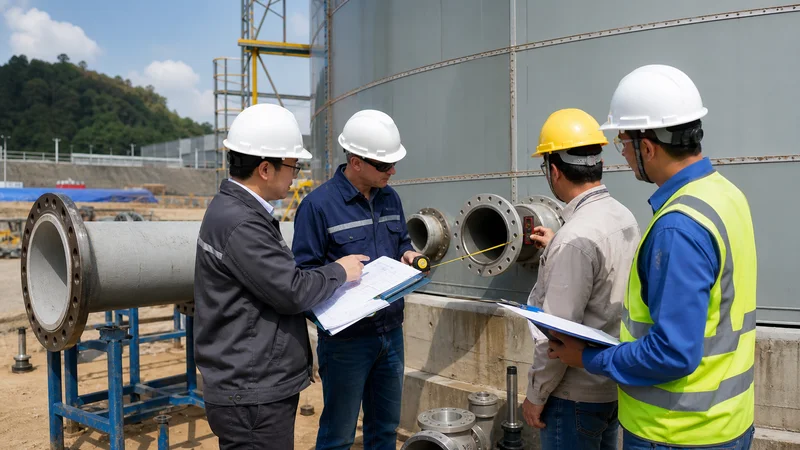
Storage tank installation does not happen in isolation. The tank package must connect with civil works, piping, valves, platforms, instruments, drainage, and later commissioning work. Among these interfaces, nozzle and piping coordination is one of the most important because late mismatches can delay installation, force field corrections, or create responsibility disputes between the owner, EPC contractor, installer, and tank supplier.
A nozzle and piping interface review helps the project team confirm that tank drawings, piping drawings, site layout, flange details, access space, and support responsibility are aligned before installation starts. It is not the same as general drawing review. It focuses on the connection points where the tank package meets the site piping system.
Why nozzle interface review matters
Tank nozzles may connect to inlet lines, outlet lines, overflow lines, drains, vents, recirculation lines, instruments, sampling points, or process piping. If orientation, elevation, size, flange standard, gasket expectation, or pipe clearance is unclear, the site team may discover the problem only after panels are erected or piping spools are fabricated.
These issues can be expensive because tank assembly, piping fabrication, and civil works are often handled by different teams. A structured interface review gives each party a chance to confirm its own scope and identify questions before site work becomes difficult to adjust.
Start from approved drawings and latest records
The review should begin with the latest approved general arrangement drawing, nozzle schedule, piping layout, foundation interface notes, and project responsibility matrix. The team should confirm that everyone is using the same revision. If an older drawing is used for piping fabrication while the tank supplier works from a newer revision, the risk of mismatch increases.
The article on drawing review and revision control before production explains why final revision status should remain visible. Nozzle and piping review depends on that same discipline, but applies it to site connection points.
Check nozzle orientation, elevation, and access
Nozzle location should be reviewed against process needs, piping route, maintenance access, valve operation, platform access, and safe installation space. Orientation on the drawing should be understood by the site team, not only by the design office. Elevation should also be checked against foundation level, connected equipment, pipe slope, drain requirement, and field access.
Access matters because a nozzle that is technically correct on paper may still be difficult to connect, inspect, operate, or maintain if nearby structures, platforms, ladders, pipe supports, or civil works are not coordinated.
Confirm flange and connection details
The project team should confirm nozzle size, connection type, flange standard, pressure rating where relevant, bolt pattern, gasket expectation, mating flange responsibility, and any blind flange or shipping protection requirement. These details should match both the tank package and the piping package.
If the tank supplier provides one side of the connection and the piping contractor provides the mating component, the responsibility split should be visible. Missing or mismatched connection details can lead to urgent site questions when installation is already underway.
Review pipe supports and tank load boundaries
Piping should not place unintended loads on tank nozzles. The team should confirm who designs and installs pipe supports, whether the piping route allows movement or settlement as required, and whether the tank nozzle is being treated as a support point by mistake. This is especially important where large-diameter piping, valves, pumps, or rigid pipe spools connect to the tank.
The tank supplier, EPC engineer, piping contractor, and installer should understand the boundary between tank supply and piping support. That boundary should be documented before connection work begins.
Connect interface review with site readiness
Nozzle and piping checks should be part of installation readiness, not a separate last-minute activity. Before tank assembly starts, the site team should confirm that foundation works, material storage, piping fabrication status, lifting access, and interface documents are coordinated.
The industrial tank installation preparation checklist covers broader site readiness. For materials already delivered to site, temporary storage protection also helps keep parts and documents available for interface review.
Use RFI records for unclear points
If the site team is unsure about nozzle orientation, flange compatibility, pipe clearance, platform interference, or responsibility for mating components, the question should be recorded rather than handled through informal messages. A clear RFI should include drawing reference, photos if available, requested decision, responsible party, and schedule impact.
The RFI and technical clarification log gives a practical structure for managing these questions until they are answered and closed.
Practical interface review checklist
- Confirm latest tank drawing, nozzle schedule, piping layout, and revision status
- Check nozzle size, orientation, elevation, connection type, and flange details
- Review piping route, pipe slope, valve access, maintenance space, and platform clearance
- Clarify responsibility for mating flanges, gaskets, bolts, blind flanges, and shipping protection
- Confirm pipe supports and avoid unintended piping loads on tank nozzles
- Identify interference with ladders, platforms, roof parts, civil works, drains, or instruments
- Record open questions through RFI or change control when scope, cost, or schedule is affected
Where product scope fits
Nozzle and piping coordination is easier when the selected tank route and supply scope are clear. Buyers reviewing storage solutions can start with product information such as GFS tanks, then connect the selected tank package with project drawings, nozzle details, piping responsibility, site installation planning, and final handover records.
Practical takeaway
A nozzle and piping interface review reduces avoidable field corrections in storage tank projects. By checking drawing revision, nozzle orientation, flange details, pipe supports, clearance, access, and responsibility boundaries before installation, the owner, EPC team, installer, and tank supplier can move into site work with fewer open technical risks.