
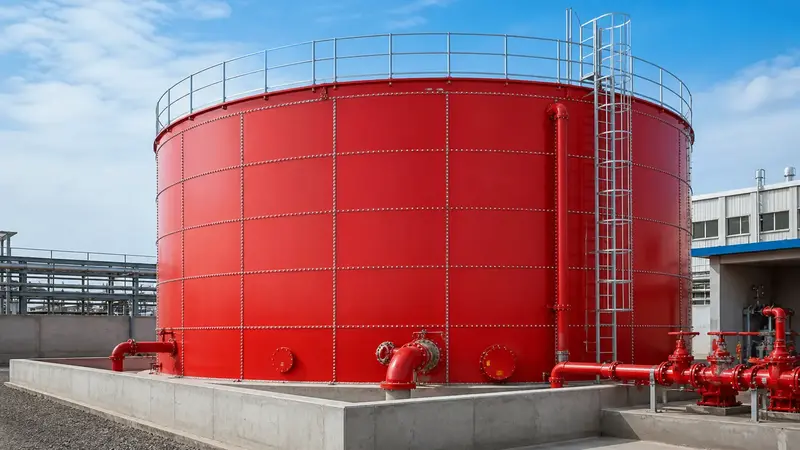
Fire water storage is often reviewed as a safety-related system, so the tank package should be checked more carefully than a general water storage request. Epoxy coated tanks may be considered where the project requires bolted steel construction, corrosion protection, practical installation, and a clear document package for owner or consultant review.
Start with the fire water project basis
Before reviewing an epoxy coated fire water tank, buyers should confirm the required storage volume, usable volume, project location, design expectation, wind or seismic condition, roof scope, nozzle arrangement, overflow, drain, access hatches, and maintenance route. If the project follows an owner specification or a local fire authority requirement, that requirement should be shared before the supplier prepares a final proposal.
Coating review should match the stored water and environment
Clean fire water may look simple, but coating review still needs context. Outdoor exposure, local climate, roof selection, maintenance cycle, installation handling, and long-term inspection access all influence the tank package. Buyers should ask what coating system is proposed, what inspection references support it, and how panels or accessories are protected during packing and installation. The broader quality-control logic is explained in our GFS tank manufacturing quality control article, and the same discipline applies when comparing epoxy coated tank packages.
Documents buyers should request
A practical document package may include company profile, certificate archive, tank proposal, general arrangement references, nozzle schedule, roof and accessory list, coating notes, packing method, and installation guidance. If the project needs formal submittals, buyers should identify mandatory documents early rather than asking for them after commercial negotiation. The fire water storage tank document review gives a broader checklist for this stage.
Compare complete package scope
Two epoxy coated fire water tank proposals can be difficult to compare if one includes roof, ladders, platforms, nozzles, sealants, bolts, packing, and installation notes while the other mainly quotes the tank shell. Buyers should compare the same scope and confirm exclusions clearly. When product-level information is needed, the main product site includes a dedicated page for epoxy coated fire water tanks.
Installation readiness matters
Fire water tank installation still requires foundation readiness, unloading access, lifting equipment, panel staging, bolt tightening tools, and safe work access. If the receiving team cannot identify accessories or the site is not ready, the tank package may wait while costs increase. For site-side preparation, review the industrial tank installation preparation checklist.
Practical takeaway
An epoxy coated fire water tank should be reviewed as a complete project package. Capacity, coating route, accessories, roof, installation responsibility, and documents should be aligned before purchase approval so the buyer can compare suppliers on a consistent basis.
Confirm the governing fire-water requirement before comparing tanks
For fire protection projects, the tank discussion should begin with the governing requirement. Some projects reference NFPA 22 for water tanks used in private fire protection; others follow local fire authority rules, owner standards, insurance requirements, or consultant specifications. Buyers should not assume that a tank is acceptable only because it stores fire water. The applicable requirement should be confirmed by the project owner, consultant, or authority having jurisdiction before final procurement.
This is especially important when comparing epoxy coated tanks with GFS tanks, welded tanks, concrete tanks, or other routes. Each route may be technically workable in some conditions, but the approval basis, inspection expectation, roof scope, access requirement, and maintenance practice can differ. The supplier can support the document package, but the final project requirement must come from the project specification and local approval process.
Nominal capacity and usable capacity should be separated
Fire water tank review should distinguish nominal tank volume from usable fire-water volume. Freeboard, overflow elevation, suction arrangement, dead storage, anti-vortex or outlet details, and pump connection assumptions can affect the usable volume available to the fire protection system. If the buyer only asks for a nominal capacity, proposals may not be comparable.
A practical inquiry should state required usable volume where known, design water level, overflow level, outlet elevation, drain requirement, inlet and outlet arrangement, roof or cover expectation, and whether the tank connects to pumps, hydrants, sprinklers, or a wider private fire main. These details help the supplier prepare a package that aligns with the fire protection designer’s intent rather than a generic storage tank quotation.
Epoxy coating review needs handling and inspection details
For epoxy coated bolted tanks, coating performance depends not only on the coating material but also on panel preparation, coating application, curing or process control, packing protection, and site handling. Buyers should ask how coating damage is prevented during shipping and unloading, how panels are inspected before packing, and what repair or touch-up procedure applies if coating damage is found before or during installation.
The review should also cover bolts, sealants or gaskets, nozzle areas, roof interfaces, ladders, platforms, vents, and manways. These items are often where scope differences appear between suppliers. A technically useful proposal should state whether the quoted package includes these items and how each item is protected or documented.
Fire water document package checklist
- Project standard or authority requirement stated by the buyer or consultant
- Nominal volume, usable volume, design water level, overflow, drain, and outlet details
- Tank shell, roof, access, ladders, platforms, nozzles, vents, and manway scope
- Coating system notes, inspection references, packing method, and site handling guidance
- Installation responsibility, foundation assumptions, and submittal document requirements
These details do not make the article a substitute for fire protection engineering review. They give buyers a clearer way to compare supplier proposals before asking the main product team for a final tank quote.