
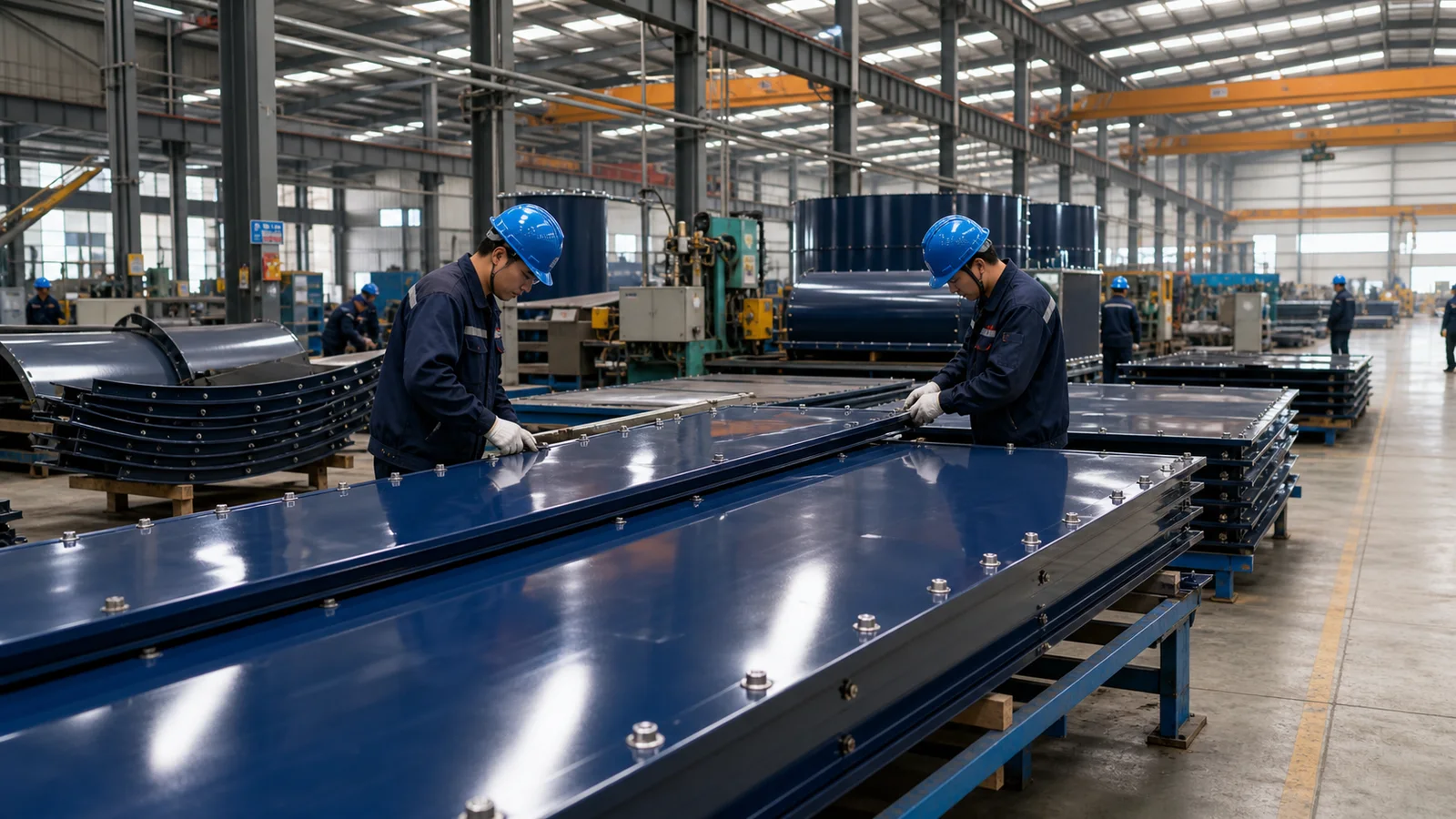
For international storage projects, tank quality is not only a matter of steel thickness or coating appearance. Buyers need to understand whether the manufacturer can control panel preparation, enamel coating, inspection, packing, and documentation in a repeatable way. This is why Center Enamel presents manufacturing capability together with certificate documents and project support materials.
Panel preparation before coating
Glass-Fused-to-Steel tank quality starts before enamel is applied. Steel sheets need accurate cutting, edge preparation, punching, bending, and surface treatment so the coating can bond correctly during firing. Poor preparation can create weak points that become visible only after installation or long service. The basic factory workflow is introduced on our manufacturing capability page.
Enamel coating and firing control
GFS tanks rely on a fired enamel layer that becomes integrated with the steel surface. Production control normally covers enamel formula stability, spraying uniformity, tunnel oven temperature, firing time, coating thickness, color consistency, and visual inspection. These checks help the tank panels maintain corrosion resistance in water, wastewater, biogas, leachate, and industrial storage applications.
Inspection before packing
Quality control should include impact, adhesion, acid and alkali resistance, coating thickness, holiday testing, and panel dimension checks. For export projects, inspection records and packing lists also matter because the installation team must receive the right panels, accessories, bolts, sealants, ladders, nozzles, and roof components on site.
Traceability and export packing
Bolted tank projects are assembled from many panels and accessories, so clear marks and packing lists are part of quality control. Panel numbers, accessory packages, nozzle schedules, roof components, and installation hardware should be easy to identify after container unloading. This reduces site sorting time and helps contractors keep installation in sequence.
Why documentation matters
Project buyers often review manufacturing capability together with ISO certificates, tank standard references, packing documents, and installation guidance. A well-organized document package reduces uncertainty before procurement and helps EPC teams communicate requirements internally. For certificate scope and review points, see our article on industrial tank certifications for buyer review.
Practical review suggestion
When comparing tank suppliers, buyers should ask for more than a price sheet. Useful review materials include company profile, coating process notes, QC references, packing method, installation support scope, and related project experience. These documents help confirm whether a supplier is prepared for international project communication, not just factory production.
Buyer-side quality review checklist
When a buyer reviews GFS tank manufacturing quality, the first question should be whether the supplier can show a controlled process from raw steel sheet to packed tank panels. A useful review normally covers steel grade confirmation, panel cutting accuracy, edge treatment, punching position, bending consistency, coating process, firing control, final inspection, and packing identification. These points are connected: a well-fired coating cannot fully compensate for poor panel preparation, and accurate panels can still create site problems if packing marks and accessory lists are unclear.
For international projects, buyers should also check whether production records and inspection references can be organized in a way that the owner, consultant, EPC contractor, and installation team can understand. This is especially important when the project requires formal submittals, because quality evidence must be traceable rather than only described in sales language.
What inspection items usually mean in practice
Holiday testing, coating thickness review, impact testing, adhesion checks, acid and alkali resistance references, and color difference checks each answer a different quality question. Holiday testing helps identify coating discontinuity; thickness review helps confirm the coating route; impact and adhesion checks relate to handling resistance; chemical resistance references help project teams judge whether the panel surface is suitable for the intended storage environment. These tests should be interpreted together with stored media, temperature, pH range, roof selection, and installation conditions.
How quality control affects project execution
Quality control is also a schedule issue. If panel dimensions, bolt holes, nozzles, and accessories are not controlled, the installation team may spend time correcting avoidable problems on site. If packing marks are unclear, the team may lose time sorting panels before lifting begins. For that reason, manufacturing quality should be reviewed together with installation planning. The industrial tank installation preparation checklist explains how foundation, unloading, lifting, and document control affect the same project outcome.
Questions to ask before placing an order
- Which coating route and inspection items are relevant to the stored media?
- How are panels marked, packed, and matched with the installation sequence?
- What documents can be provided for project submittal and buyer qualification?
- How are nozzles, roof parts, ladders, platforms, and sealants checked before shipment?
- Who confirms the foundation interface and installation responsibility before production?
These questions help move the discussion from general product claims to a project-ready quality review.
Common misunderstanding in quality comparison
Buyers sometimes compare GFS tank suppliers by looking only at coating thickness or a single test item. This is too narrow. A reliable tank package depends on the consistency of the whole process: steel sheet preparation, enamel formulation, firing control, panel geometry, accessory matching, packing marks, and installation support. A supplier with stronger process discipline can often reduce hidden project risks even when two quotations appear similar on paper.
Another misunderstanding is to treat quality control as a factory-only issue. For bolted tanks, quality continues through container loading, site unloading, panel handling, sealant application, and bolt tightening. A good review should therefore connect factory inspection with logistics and installation documents.
For buyers who need a product-side overview after reviewing factory quality, the main product site introduces Glass-Fused-to-Steel tanks with project-oriented product information.