
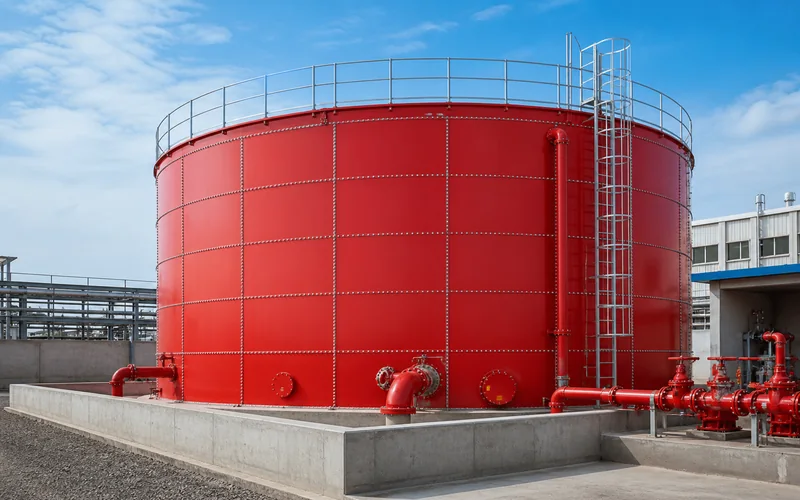
Fire water storage projects often look straightforward because the stored media is normally clean water. In practice, buyer review still needs careful coordination between tank capacity, local fire code expectations, foundation design, access, roof type, corrosion protection, and project documentation. A fire water tank is usually part of a wider safety system, so unclear scope can delay approvals or create revisions during procurement.
Start with the project basis
Before comparing tank proposals, buyers should confirm required capacity, usable volume, project location, design standard reference, seismic or wind load requirement, roof expectation, inlet and outlet arrangement, overflow, drain, access hatches, ladder and platform scope, and whether insulation or freeze protection is relevant. These items help the supplier prepare a tank package that matches the project rather than a generic water storage quotation.
Tank route and corrosion protection
Fire water tanks may be reviewed as GFS tanks, epoxy coated tanks, galvanized tanks, stainless steel tanks, welded tanks, or other routes depending on local practice and project requirements. For buyers comparing technical options, the main product site provides a dedicated overview of fire water tanks. On the Center Enamel side, the coating and quality background can be reviewed through our GFS tank manufacturing quality control article.
Documents buyers should request
A practical document package may include company profile, certificate files, tank proposal, drawing references, nozzle schedule, accessory list, coating references, packing plan, installation notes, and project reference information. If the project owner or consultant has a formal submittal list, the supplier should understand that list before production release. This is especially important when the tank is part of a municipal, industrial, airport, factory, or infrastructure fire protection system.
Installation and site coordination
Fire water tanks still require disciplined site preparation. Foundation levelness, access for unloading, crane or lifting method, panel staging area, bolt tightening tools, sealant application conditions, and safety access should be confirmed early. The installation preparation checklist gives a broader review structure for bolted storage tank site work.
Practical takeaway
A fire water tank proposal should be reviewed as a complete project package, not only as a tank shell. When capacity, standards, accessories, coating route, roof requirement, and submittal documents are clear, buyer-side comparison becomes more accurate and approval risk is reduced.
Submittal review should happen before production release
For fire water storage projects, late document changes can affect production, packing, and installation. Buyers should try to complete the main submittal review before production release, especially when drawings, nozzle positions, roof access, overflow details, or foundation interface notes are involved. If the owner or consultant has a required format for drawings, certificates, inspection records, or packing lists, that requirement should be shared early.
A practical submittal package can include tank general arrangement, shell and roof scope, nozzle schedule, ladder and platform notes, coating or material route, certificate references, packing method, and installation responsibilities. Some projects may also require local fire authority review. The supplier should understand whether the buyer needs technical documents for internal purchase approval, consultant review, or formal project submission.
Fire water tanks need reliable access and maintenance planning
Access should not be treated as a minor accessory. Fire water tanks may require ladders, platforms, manways, vents, overflow, drain, inspection access, and safe routes for maintenance teams. The arrangement should be discussed together with local site restrictions and owner operation practice. If the tank is located in a remote industrial site, airport, factory, or utility area, access and inspection planning can affect long-term usability.
Maintenance planning also influences roof and coating review. A tank that is difficult to inspect may create higher long-term risk even if the initial purchase price is lower. For that reason, the buyer should compare not only tank shell cost but also the completeness of the access, roof, accessory, and document package.
How to compare supplier proposals
When comparing proposals, buyers should check whether the same capacity, design assumptions, roof scope, accessories, coating route, packing scope, and installation support are included. If one proposal excludes access platforms, roof details, installation notes, or document support, it should not be compared directly with a fuller package. A clear comparison table can prevent confusion between price differences and scope differences.
Fire water storage is usually a safety-related system, so uncertainty should be reduced before procurement. The best supplier response is not only fast; it is technically clear, document-ready, and connected to project approval needs.
Official reference for fire water storage
The NFPA 22 page is a useful official reference when buyers are reviewing water tanks for private fire protection. Project teams should still confirm whether NFPA 22 is mandatory for the job, how local fire authorities interpret the requirement, and which documents must be submitted with the tank proposal.