
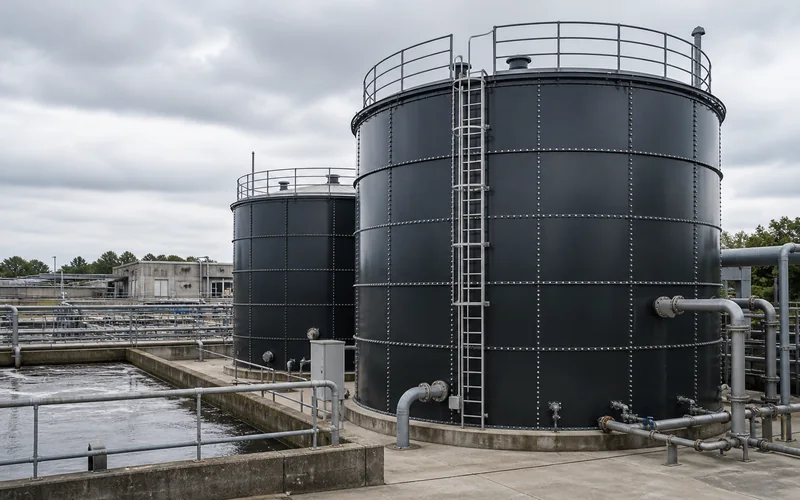
Potable water and wastewater projects may look similar from a distance because both require large storage capacity. In practice, stored media, approval requirements, corrosion risk, odor control, roof needs, and site conditions can be very different. A good tank selection process starts with the project environment rather than only the tank capacity.
Potable water review points
Potable water projects often focus on hygienic storage, applicable drinking water references, roof sealing, inlet and outlet arrangement, overflow, access, and maintenance planning. Buyers may need to review NSF/ANSI 61, WRAS, or local approval expectations depending on the market. Relevant certificate information is listed in our certification document archive.
Wastewater review points
Wastewater storage may require stronger attention to corrosion resistance, pH range, gas exposure, sludge handling, mixing, odor control, and roof or cover selection. The tank material route should be reviewed together with actual media data. This is especially important when the stored liquid may vary by treatment stage or industrial source.
Tank route comparison
GFS tanks, epoxy coated tanks, stainless steel tanks, HDG tanks, and other storage systems can each fit different conditions. A practical comparison should include service environment, installation schedule, maintenance expectation, budget, accessories, and document requirements. For GFS coating fundamentals, see our guide to Glass-Fused-to-Steel tank coating basics.
Roof and accessory decisions
Water and wastewater projects often need careful review of roofs, vents, manways, ladders, platforms, nozzles, overflow, level measurement, and safety access. Roof selection may be influenced by odor control, rainwater exclusion, gas handling, wind load, snow load, and maintenance access.
Early information that helps manufacturers
Project teams can speed up review by sharing capacity, location, stored media, temperature, pH, design standard, roof requirement, nozzle list, foundation condition, installation responsibility, and any local approval requirements. Clear information leads to clearer proposals.
How to avoid unclear comparisons
When comparing suppliers, make sure each proposal is based on the same capacity, diameter, height, roof scope, accessory list, coating route, and installation responsibility. Otherwise the lowest price may reflect a different technical scope rather than a more competitive solution.
Potable water and wastewater should not share the same checklist
Potable water projects normally focus on hygienic storage, applicable water-related documents, roof sealing, inlet and outlet arrangement, overflow, maintenance access, and avoidance of contamination. Wastewater projects often focus on corrosion exposure, odor, sludge, gas, pH range, roof or cover selection, and equipment interfaces. Both projects may require bolted tanks, but the review logic should be different from the beginning.
Information needed for potable water review
For potable water storage, buyers should clarify capacity, site location, local approval expectations, required water-contact references, roof type, ventilation, overflow, access hatches, inlet and outlet positions, and cleaning or maintenance planning. NSF/ANSI 61 or WRAS references may be relevant depending on market and owner requirements, but local approval should be confirmed by the project owner or consultant. The certification archive provides document references for this early review.
Information needed for wastewater review
Wastewater projects need more detailed media information. Useful data includes pH range, temperature, chemical exposure, suspended solids, gas generation, odor control needs, mixing equipment, sludge handling, and whether the tank is used for equalization, treatment, storage, or emergency buffering. For challenging media such as leachate or industrial wastewater, review the dedicated article on leachate and industrial wastewater tank review points.
Comparing tank routes fairly
GFS tanks, epoxy coated tanks, stainless steel tanks, HDG tanks, and other storage routes can each fit different project conditions. A fair comparison should use the same capacity, roof scope, accessory list, design assumptions, installation scope, and document requirements. Otherwise, a lower price may simply mean that one proposal excludes important accessories, roof details, or installation support.
Buyer takeaway
The best tank route is not chosen by material name alone. It is chosen by matching stored media, approval expectations, site conditions, roof requirement, maintenance plan, and supplier document readiness. Clear early information leads to clearer technical proposals and fewer changes during procurement.
Common comparison problems
Tank comparisons become unreliable when proposals are not based on the same scope. One supplier may include roof, ladders, platforms, nozzles, sealants, bolts, packing, and installation guidance, while another supplier may quote mainly the shell package. The price difference may look attractive, but the buyer may later discover missing items or unclear responsibilities.
For potable water and wastewater projects, buyers should also avoid using one material rule for every site. Local approvals, climate, foundation, installation access, media data, and maintenance expectations can all change the suitable route. A practical selection process compares the complete storage system, not only the tank wall material.
For product-level comparison after early selection, buyers can review industrial water tanks and related storage routes on the main product site.
Official references for water project review
For potable water projects, buyers can use official background from NSF/ANSI/CAN 61 when discussing drinking-water system component requirements. This should be combined with local authority expectations, project location, water quality, and the supplier certificate package rather than treated as a standalone approval decision.