
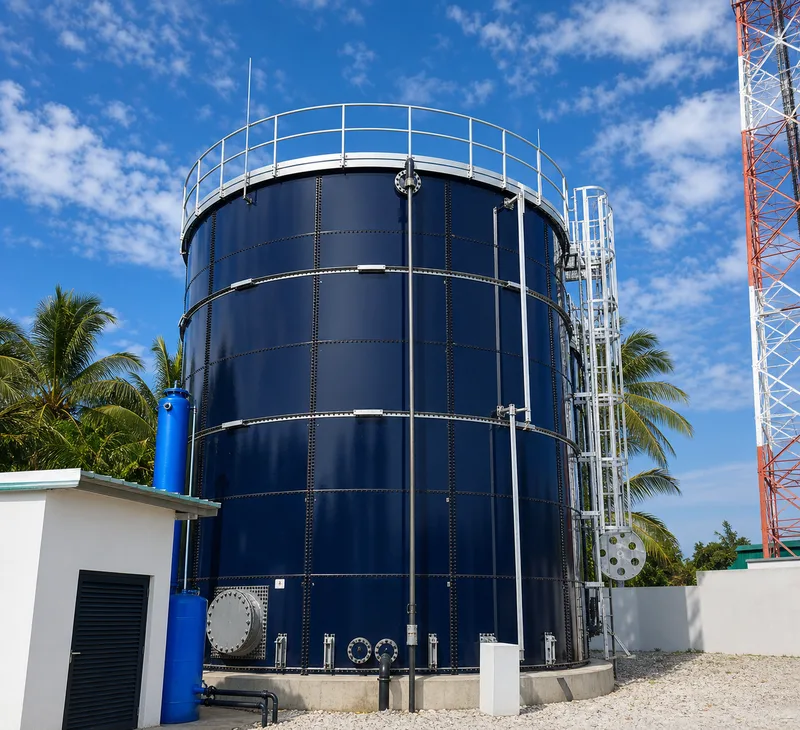
Glass-Fused-to-Steel tanks combine steel strength with a fired inorganic coating. This makes them suitable for many storage projects where corrosion resistance, modular installation, and long-term maintenance planning are important. Project teams that understand the coating route can write clearer specifications and ask better technical questions.
What makes GFS coating different?
The enamel layer is fired at high temperature so it bonds with the steel surface. Unlike a simple painted surface, the coating becomes part of the panel system. This is why steel preparation, enamel formula, spraying, firing, and inspection all need to be controlled together. The broader production route is summarized in our manufacturing capability overview.
Common coating checks
Project teams often ask about coating thickness, holiday testing, adhesion, impact resistance, acid and alkali resistance, and color difference. These checks help verify that the tank panels meet the intended operating environment and handling requirements. The right check list depends on stored media, pH, temperature, and handling conditions.
Where GFS tanks are commonly used
GFS tanks are widely used in potable water, wastewater, fire water, leachate, biogas, and industrial storage projects. Application suitability still depends on stored media, pH range, operating temperature, roof requirement, foundation design, and local installation conditions. For water and wastewater comparison points, read our storage tank selection notes.
Specification review tips
Before procurement, teams should align capacity, tank diameter, shell height, roof type, nozzles, ladders, platforms, accessories, foundation assumptions, and installation method. This reduces revision cycles and helps the manufacturer prepare a more accurate technical proposal.
Do not separate coating from project context
A strong coating system still needs correct project information. Media data, roof type, nozzle arrangement, installation environment, foundation interface, and local approval requirements all influence the final tank package. The coating should be reviewed as part of a complete storage system rather than as an isolated product feature.
What Center Enamel can provide
For project review, Center Enamel can provide company profile materials, coating and QC references, certificate documents, and basic technical communication support. These materials help buyers evaluate whether GFS tanks are a suitable route for their storage project before detailed design work begins.
Coating review should start with the service environment
GFS coating is often discussed as a product feature, but the correct review starts with the service environment. Project teams should identify the stored media, pH range, operating temperature, expected cleaning method, gas exposure, solids content, and whether the tank will be installed indoors or outdoors. A potable water tank, municipal wastewater tank, landfill leachate tank, and anaerobic digestion tank may all use bolted tank structures, but the coating review questions are not identical.
Understanding coating routes without over-simplifying them
Project documents may refer to coating and firing routes such as 2C1F, 2C2F, or 3C3F. These terms describe coating and firing sequences, but they should not be treated as a universal ranking without context. The appropriate route depends on stored media, corrosion exposure, project specification, expected service environment, and supplier technical recommendation. Buyers should ask what coating route is proposed, what inspection items support that proposal, and whether the route matches the project conditions.
Inspection evidence buyers can request
For a GFS tank project, useful inspection evidence may include coating thickness references, holiday test references, impact and adhesion checks, visual inspection criteria, panel dimension checks, and packing inspection notes. These are most useful when they are connected to the actual tank package instead of provided as generic brochure statements. If the project requires formal submittals, the inspection evidence should be organized with the technical proposal and certificate package.
Coating and installation are connected
Even a suitable coating route can be damaged by poor handling or site preparation. Panels should be protected during loading, unloading, and staging. The installation team should avoid unnecessary impact, dragging, or contamination of sealing areas. Nozzle installation, bolt tightening, sealant application, and roof interface details also affect long-term service. For site preparation details, review the installation preparation checklist.
Useful specification information
- Stored media and expected pH range
- Operating temperature and whether gas exposure is expected
- Tank capacity, diameter, height, and roof requirement
- Nozzle schedule, mixer or equipment interface, and access requirement
- Local standard or owner specification requirements
With this information, the coating discussion becomes more accurate and less dependent on generic comparisons.
How project teams can discuss coating without ambiguity
A useful coating discussion should avoid vague phrases such as “best coating” or “highest grade” unless the operating environment is defined. Project teams should describe the stored media, expected pH range, temperature, chemical exposure, cleaning method, roof condition, and whether gas exposure may occur. The supplier can then explain the proposed coating route and inspection items in relation to those conditions.
It is also important to confirm what is included in the coating-related scope. Shell panels, roof panels, nozzles, accessories, bolts, and internal parts may have different material or coating routes. If the project has aggressive media or strict approval requirements, these details should be reviewed before the proposal is finalized.
When the coating route is clear and the buyer is ready to compare product scope, the dedicated GFS tanks page can be used together with this coating review.