
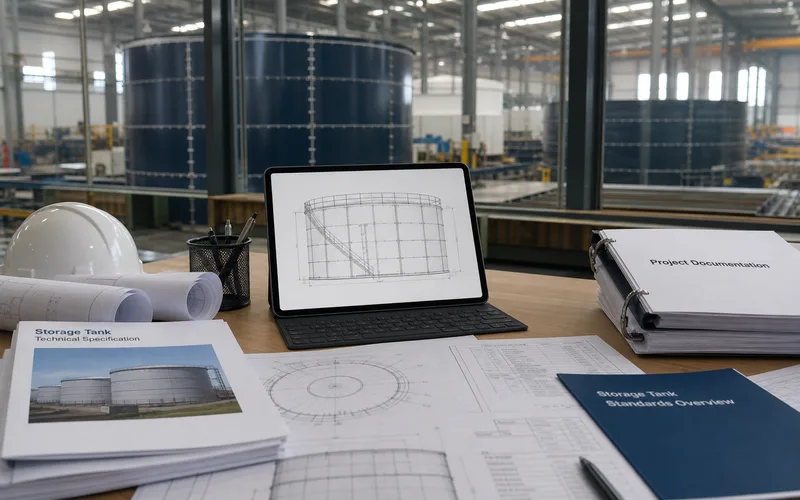
Tank standards help buyers compare proposals more accurately, but they should not be treated as simple labels. AWWA D103, ISO 28765, API 650, NFPA 22, and potable water references answer different questions about tank structure, coating, fabrication route, inspection, fire protection, and drinking-water contact. The first task is to identify which standard is mandatory for the project and which references are useful for supplier review.
Start with the application and authority requirement
A potable water reservoir, a municipal wastewater tank, a fire protection water tank, an oil storage tank, and an industrial process water tank may all be large storage systems, but the review logic is not the same. Buyers should first confirm project location, stored media, owner specification, consultant requirement, local authority expectation, and whether the standard is required by contract or only used for early comparison.
For company-side document review, buyers can combine standard references with the Center Enamel certification archive. For product-side comparison after the standard route is clearer, the main product site provides pages for GFS tanks, welded steel tanks, and related tank families.
AWWA D103 and bolted water tanks
AWWA D103 is commonly discussed for factory-coated bolted carbon steel tanks used in water storage. In buyer review, it normally leads to questions about panel fabrication, factory coating route, bolted assembly, accessories, inspection references, foundation interface, and installation documentation. The standard reference should be connected to the full tank package, not only the tank shell.
ISO 28765 and Glass-Fused-to-Steel tanks
ISO 28765 is relevant when the project team is reviewing vitreous and porcelain enamel coated bolted steel tanks. For GFS tanks, the buyer should ask how coating preparation, firing route, coating thickness checks, holiday testing, packing, and site handling are controlled. Our GFS tank coating basics article explains why the coating route must be tied to stored media and project conditions.
API 650 and welded steel tank projects
API 650 is usually reviewed for welded aboveground storage tank projects. It can affect design assumptions, shell details, roof selection, welding procedure, inspection planning, foundation coordination, and site fabrication responsibilities. Buyers comparing API 650 welded tanks with bolted tank routes should compare engineering scope, site work, inspection scope, coating or lining responsibility, and schedule impact.
NFPA 22 and fire water storage
For fire protection water storage, NFPA 22 may appear as a reference depending on authority and project specification. In practice, buyers should confirm required capacity, usable volume, fire pump demand, refill assumptions, roof and venting, access, freezing or environmental conditions, and inspection responsibility. The related fire water storage tank document review gives a broader document checklist for this application.
Potable water references and local approval
For potable water storage, water-contact references such as NSF/ANSI/CAN 61 or WRAS may be relevant depending on country and approval route. These references do not replace local authority confirmation. Buyers should ask whether the relevant components, coating, sealants, and accessories fit the project requirement and whether the supplier can provide documents in the format expected by the owner or consultant.
How to compare proposals fairly
A fair standard-based comparison should use the same stored media, design assumptions, tank capacity, roof scope, nozzle schedule, access systems, coating or lining expectation, inspection documents, packing scope, installation responsibility, and approval requirements. If these items are not aligned, a price comparison may hide major differences in scope.
Practical buyer checklist
- Is the standard mandatory, preferred, or only a reference for discussion?
- Which party is responsible for design confirmation, local approval, inspection, and installation?
- Does the proposal include roof, nozzles, ladders, platforms, vents, bolts, sealants, and documents?
- Are coating, water-contact, fire protection, or corrosion requirements tied to the stored media?
- Can the supplier provide company profile, certificates, drawings, packing notes, and installation guidance?
When standards are reviewed this way, buyers can move from name-based comparison to project-ready evaluation.
Practical reference sources
For non-competitor background, buyers can review the official standard organizations and standard pages from AWWA D103, ISO 28765 search results, API 650, NFPA 22, and NSF/ANSI/CAN 61. These links are references for buyer education; the actual project requirement should be confirmed through the owner, consultant, and local approval authority.