
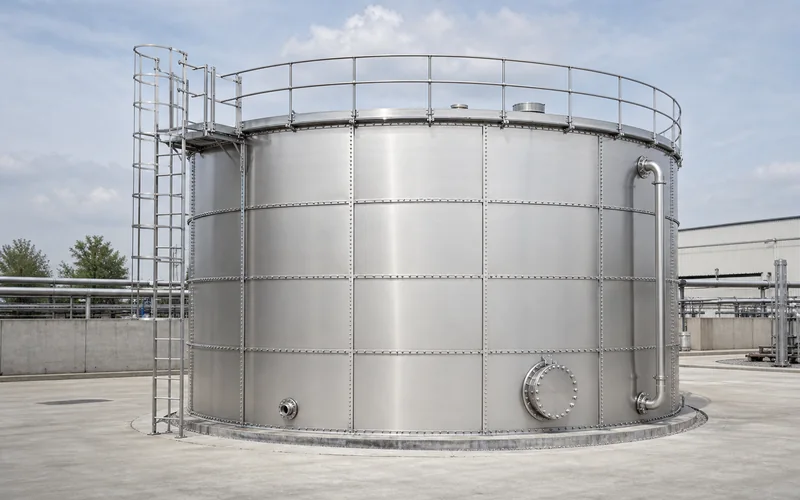
Stainless steel bolted tanks may be reviewed for projects where corrosion resistance, cleanability, material compatibility, or owner preference makes stainless steel a serious option. The review should still be project-led. Stainless steel is not a shortcut around engineering questions; buyers still need to define stored media, site condition, roof scope, accessories, installation method, and documentation requirements.
Clarify why stainless steel is being considered
The first review question is not only “stainless steel or not.” Buyers should identify why stainless steel is being considered: potable water expectations, process water, industrial liquid compatibility, food or beverage wastewater, chemical exposure, maintenance preference, or project specification. The answer affects material grade discussion, nozzle scope, roof selection, and accessory choices.
Material route and accessory scope
A stainless steel tank package may include stainless shell panels, specific nozzles, manways, ladders, platforms, bolts, gaskets, and roof interfaces. These items should not be assumed. If some accessories use another material or coating route, the proposal should state that clearly. This helps avoid a situation where the tank shell is reviewed carefully but smaller components are left ambiguous.
Documents that support supplier evaluation
Project teams may request company profile, material notes, general arrangement references, nozzle schedule, accessory list, packing method, certificate documents, and installation guidance. The bolted tank project documentation checklist provides a structure for organizing these files, while the certification archive supports buyer-side qualification review.
Installation and handling requirements
Stainless steel bolted tanks still need disciplined handling. Panels should be protected from damage and contamination during loading, unloading, staging, and installation. Site teams should understand the bolt tightening sequence, sealant or gasket route, roof interface, and accessory installation requirements. If the project site has limited access or strict cleanliness requirements, those conditions should be discussed before shipment.
Product-level comparison
When buyers are ready to compare product scope, the main product site has a dedicated page for stainless steel bolted tanks. The brand site should be used together with that page to review company background, factory capability, certificates, and project document readiness.
Practical takeaway
Stainless steel bolted tank review works best when material assumptions and project requirements are connected. Buyers should compare complete scope, not only material name, and confirm documents, accessories, installation support, and supplier communication before procurement.
Material grade should follow the stored media and site conditions
Stainless steel tank review should avoid vague language such as “stainless is corrosion-proof.” Stainless steel can be a strong route for many storage applications, but grade selection and detail design still depend on chloride exposure, cleaning chemicals, temperature, aeration, crevice conditions, external environment, and maintenance practice. Buyers should state whether the project involves potable water, process water, industrial wastewater, food or beverage effluent, chemical exposure, or another stored liquid.
In early discussions, project teams may mention common stainless routes such as 304 or 316, but the supplier should not finalize material assumptions without application data. If the buyer has a required material grade in the specification, that grade should be stated clearly. If the grade is open, the supplier needs enough media and site information to explain the proposed route and any limitations.
Interfaces are often more important than the tank shell alone
Many stainless steel tank issues appear at interfaces: nozzles, manways, roof connections, anchors or base details, ladders, platforms, bolts, gaskets, and connections to other metals. If stainless steel connects to carbon steel, galvanized parts, aluminum, or other materials, the proposal should clarify material transitions and protection assumptions. This is not only a purchasing detail; it affects maintenance and long-term reliability.
Buyers should also ask which parts of the package are stainless steel and which parts use another material route. A proposal that says “stainless tank” but leaves accessories undefined is not complete enough for serious comparison. The accessory list should be reviewed together with the drawings and packing list.
Cleanability and maintenance expectations should be stated early
Some projects consider stainless steel because of cleanability, appearance, or owner maintenance preference. In those cases, the buyer should describe cleaning frequency, cleaning chemicals, access needs, inspection expectations, and whether internal surfaces must be easy to wash or inspect. The tank design, roof access, manways, drains, and nozzle arrangement can all affect practical maintenance.
If the stored liquid can leave deposits, sediment, or biological growth, maintenance access becomes part of the technical review. A clean material route does not remove the need for good access and drainage planning.
Stainless steel bolted tank review checklist
- Stored media, temperature, chloride or chemical exposure, and cleaning method
- Required stainless grade or open material recommendation basis
- Material route for shell panels, nozzles, roof, bolts, gaskets, ladders, and platforms
- Connection details where stainless steel interfaces with other materials
- Inspection, packing, handling, and installation notes for contamination control
When these points are clear, stainless steel bolted tanks can be compared more fairly against GFS, epoxy coated, HDG, welded, or concrete alternatives.